

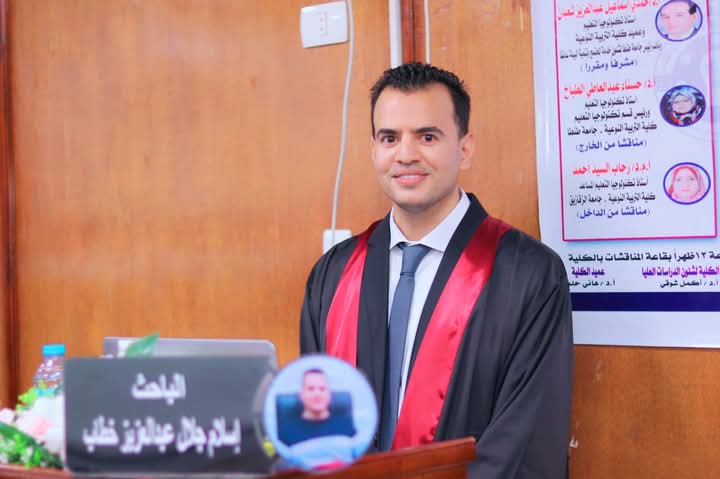
The effect of the timing of support (immediate/mixed) in the micro-training environment on developing the skills of preparing digital Portfolio files among Al-Azhar teachers.
Publication date: 2026-07-26
Designing a micro-training environment based on the interaction between the timing of support (immediate / mixed) and the cognitive style (impulsivity / reflectivity) and its impact on developing the skills of preparing digital Portfolio files for Al-Azhar teachers. Introduction: The revolution of communication and information technology has affected various fields of life, as it reached all aspects of human life to facilitate human life and increase his comfort, so this era was called the era of information and communication technology, The development of the educational process is very great, and it bears a great responsibility for everything that is new in the field of educational and educational technologies, and it must be in line with scientific and technological progress, and Al-Azhar teachers need to be trained in these skills in order to be able to produce digital portfolios (Portfolios) of their own and training on these skills through the mini-training environment. There is also educational content, tests and activities. During the teacher’s performance of the activities, they may face some difficulties and need help and support from the researcher to implement the skill steps in a correct manner , or mixed support (immediate / delayed), and this means that support will be provided once immediately, that is, he receives support directly from the researcher at the same time, and again on a delayed basis after completing the steps of performing the skill, he receives support after a certain period has passed, so the micro-training is in the form of Mini-modules is best suited for them to understand and implement these skills. And it has become necessary for the teacher to play new roles that are in line with the tremendous scientific and technological progress on the one hand and with the demands of the information and communication revolution on the other hand, and the teacher is seen in the era of the Web as a developer of school curricula and curricula, and this new task represents the basic role that he should play (Suad Shaheen Portfolio is a technological innovation in the educational process, as it is an objective and effective evaluation tool that can be relied upon in evaluating the student’s performance, as it documents the student’s educational performance, encourages him to reflective thinking, and enhances the professional growth of students. The teacher provides an opportunity to refer to his experiences, and thus provides him with feedback. (Zainab Khalifa and Ahmed Fahim, 2016, 65-66). The digital Portfolio files are the same as the paper achievement files, as they are a careful selection of a set of typical documents that indicate students’ learning in the field of study subjects in the various stages of general education, The researcher uses the American Psychological Association (APA) Documentation System - Sixth Edition, mentions (surname, year of publication, page or pages), for Arabic names, first name and surname. and they are also indicative of the teachers’ achievements, but the digital achievement files depend on what technology has produced. The era of flowing information (Hossam El-Din, 2009, 21). That is why the capabilities of the computer allow the teacher to collect, organize and present a collection of his work in the form of multiple means such as texts, graphics, sounds, and video clips, and this is what is referred to as the digital Portfolio file (Portfolio) (Iman Al-Sharif, and Wafaa Al-Dasouki, 2010, 90). The digital Portfolio file is a means of consolidating theoretical principles and cognitive skills in classroom practice, For meaningful learning, the digital achievement profile has been gaining traction in the United States recently, in part due to standards-based education reform. (Butler, 2006). A study (Kocoglu, P74, 2008) indicated that digital Portfolio files help develop reflective thinking; It provides a systematic, continuous method that supports and guides learner progress. Numerous studies and research have proven the importance of digital Portfolio files and their role in achieving many positive aspects within educational institutions, including a study (Wafaa Aoun et al., 2010; 2011; Baris, Tosun; 2011; Chin; 2013; Bekri and et all; Abdul Karim, 2015; Zainab Khalifa and Fahim Ahmed, 2019), all of which indicated the necessity of adopting digital achievement files, and the necessity of training on them; Because of the many advantages it offers that are not only reflected in the school calendar process, but also in all aspects of the educational process. Cognitive styles are among the important factors that must be taken into account when designing educational e-learning environments. Or those around him perceive it, and in organizing his experiences in his memory and how to recall them, they are the differences between the learners in the methods of perception and remembering, thinking, and the use of information and self-understanding (Suhaila Askar, and Muhammad Diab, 2016, 203), and mentions Wang, and Lu (p. 90. Wang & Lu, 2018,) that cognitive style refers to individual differences among learners when perceiving, attending to, remembering, deciding and solving problems. Cognitive styles are defined as the inference that individuals use to process information about their environment. This inference can be identified at multiple levels of information processing, from perceptual to metacognitive, and can be grouped according to the type of regulatory function that is exercised on operations ranging from automatic data coding to Conscious executive allocation of cognitive resources (464. Kozhevnikov, 2007, p). It is also defined as the processes that the individual uses to classify and organize his perception of the surrounding environment, the ways in which he responds to stimuli and the approach he takes in controlling, dealing with and directing them (125.Abd Elhade, 2010.p).