

Issue 14 of Minnesota International Journal Released
Reported by: Nader Saeed
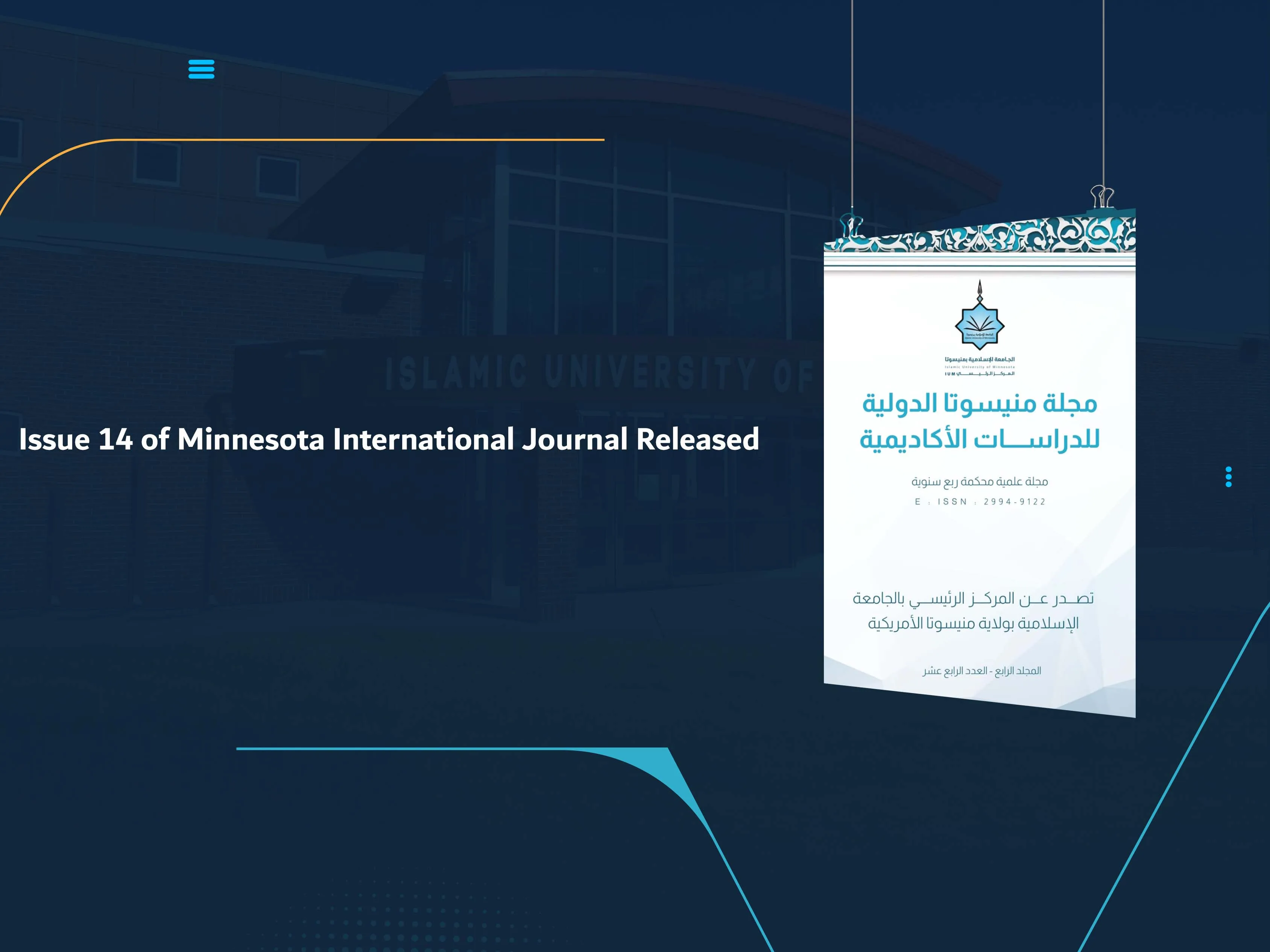
The Media Center at the Islamic University of Minnesota - Main Center has announced the publication of Volume 4, Issue 14 of the Minnesota International Journal of Academic Studies, the University's peer-reviewed quarterly scientific journal published from its Main Center in the United States. Released at the end of June 2026, the new issue represents another milestone in the journal's continued efforts to strengthen its academic presence and contribute to high-quality scholarly publishing at both regional and international levels.
The latest issue comprises 481 pages and features 15 peer-reviewed research papers published in both Arabic and English. The papers were authored by 23 researchers representing ten Arab and international countries, reflecting the journal's expanding academic collaborations and its ability to attract diverse scholarly contributions. The editorial team of the University's official news website obtained a copy of the issue following the completion of the peer-review process, linguistic editing, and final production.
Rigorous Peer Review Ensures Academic Excellence
Professor Hanan Sobhi Abdullah Obeid, Managing Editor of the Journal, stated that all submitted manuscripts underwent a comprehensive peer-review process in accordance with the highest academic standards. The process began with an initial editorial screening to verify compliance with the journal's scientific and publishing requirements, after which each manuscript was evaluated by two specialized reviewers-one internal and one external—to ensure impartiality, integrity, and academic quality.
She added that the journal honored all reviewers who contributed to this issue by presenting them with certificates of appreciation bearing each reviewer's name, the title of the reviewed manuscript, and the date of review, in recognition of their valuable scholarly contributions and their role in maintaining the journal's academic standards.
Research Addressing Contemporary Global Issues
Professor Obaid explained that the new issue reflects broad disciplinary diversity, presenting studies that address contemporary topics in artificial intelligence, digital transformation, educational sciences, Islamic studies, language and literature, media studies, history, and the social sciences.
Among the featured topics are strategic planning for university youth development in the era of artificial intelligence and digital transformation; recent developments in e-learning and mobile learning and their role in future educational systems; Islamic legal rulings and ethical considerations concerning the use of artificial intelligence in psychological care and therapy; emerging issues in digital communication and artificial intelligence; public administration in Islamic Egypt; challenges facing Arab-Islamic schools in northwestern Nigeria; Jerusalem in the poetry of Farouq Mowasi; moderation and balance in the thought of Saudi scholars; self-glorification in pre-Islamic poetry; the Islamic ruling on dyeing hair black; the impact of mothers' employment on children's psychological well-being; the effectiveness of strategic planning in Sudanese media institutions; women in Islamic society during the caliphate of Umar ibn Abd al-Aziz; and the poetry of Abdulrahman al-Dakhil. Collectively, these studies reflect the journal's commitment to addressing pressing scientific, intellectual, and societal developments.
International Scholarly Participation
Professor Obeid noted that the issue includes contributions from researchers affiliated with institutions in the United Kingdom, the United States, Palestine, Saudi Arabia, Jordan, Iraq, Somalia, Kuwait, Sudan, and Egypt, demonstrating the journal's growing international visibility and its success in attracting scholars from a wide range of academic traditions.
Three Months of Continuous Editorial Work
She further explained that preparation of the issue required three months of continuous work, extending from early April until June 30, 2026, during which the Editorial Board worked closely with the University's Media Center to ensure that the publication was completed on schedule and met the targeted scientific and technical standards.
Professor Obeid praised the collaborative spirit that characterized every stage of the publication process, emphasizing that the effective coordination between the Editorial Board and the Media Center played a significant role in the successful and timely release of the issue in accordance with the University's 2026 strategic plan.
Future Aspirations for International Indexing
Looking ahead, Professor Obeid revealed that the journal is actively working to strengthen its presence in international indexing databases by increasing citation rates, benefiting from its participation in the Arab and International Peer-Reviewed Journals Twinning Initiative for citation exchange, obtaining Digital Object Identifiers (DOIs), and ultimately pursuing inclusion in leading international indexing databases such as Clarivate and Scopus.
She also noted that the journal carries the electronic international standard serial number E-ISSN: 2994-9122, further reinforcing its status among internationally recognized electronic peer-reviewed journals.
An Integrated Editorial Structure
The journal is supervised by Professor Walid bin Idris Al-Munaisi, President of the Islamic University of Minnesota, while Dr. Omar Ahmed Al-Maqrami serves as Chairman of the Board of Directors and Editor-in-Chief. Professor Hanan Sobhi Abdullah Obaid serves as Vice Chair of the Board and Managing Editor.
Dr. Abdo Nasr Al-Sailani serves as Editorial Secretary, Language Editor, and Research Coordinator, while Associate Professor Badia Abdul Qader is responsible for the preliminary evaluation of submitted manuscripts.
The journal is supported by an Advisory Board of 49 professors and researchers, in addition to an Editorial Board comprising 49 members representing various academic ranks and disciplines, providing a comprehensive framework for managing the journal's peer-review and publication processes according to internationally recognized academic standards.
Professional Media and Production Support
The publication of the fourteenth issue received extensive media and technical support from the University's Media Center. Jordanian graphic designer Abdullah Darras was responsible for the journal's electronic design and production under the supervision of Eng. Abdullah Mohammed Al-Mansoub, Director of the Media Center. The official news coverage was prepared by Ahmed Mohammed Shamshan, News Editor of the University's official website and Editor-in-Chief of Sada Al-Jami'ah (University Echo) newspaper.
The publication of this issue marks another important milestone in the journal's ongoing mission to promote rigorous peer-reviewed scholarship, expand its regional and international academic presence, and publish original research that contributes to knowledge production while addressing contemporary scientific and humanitarian issues in accordance with the highest standards of academic publishing.