

University President Participates in International Symposium
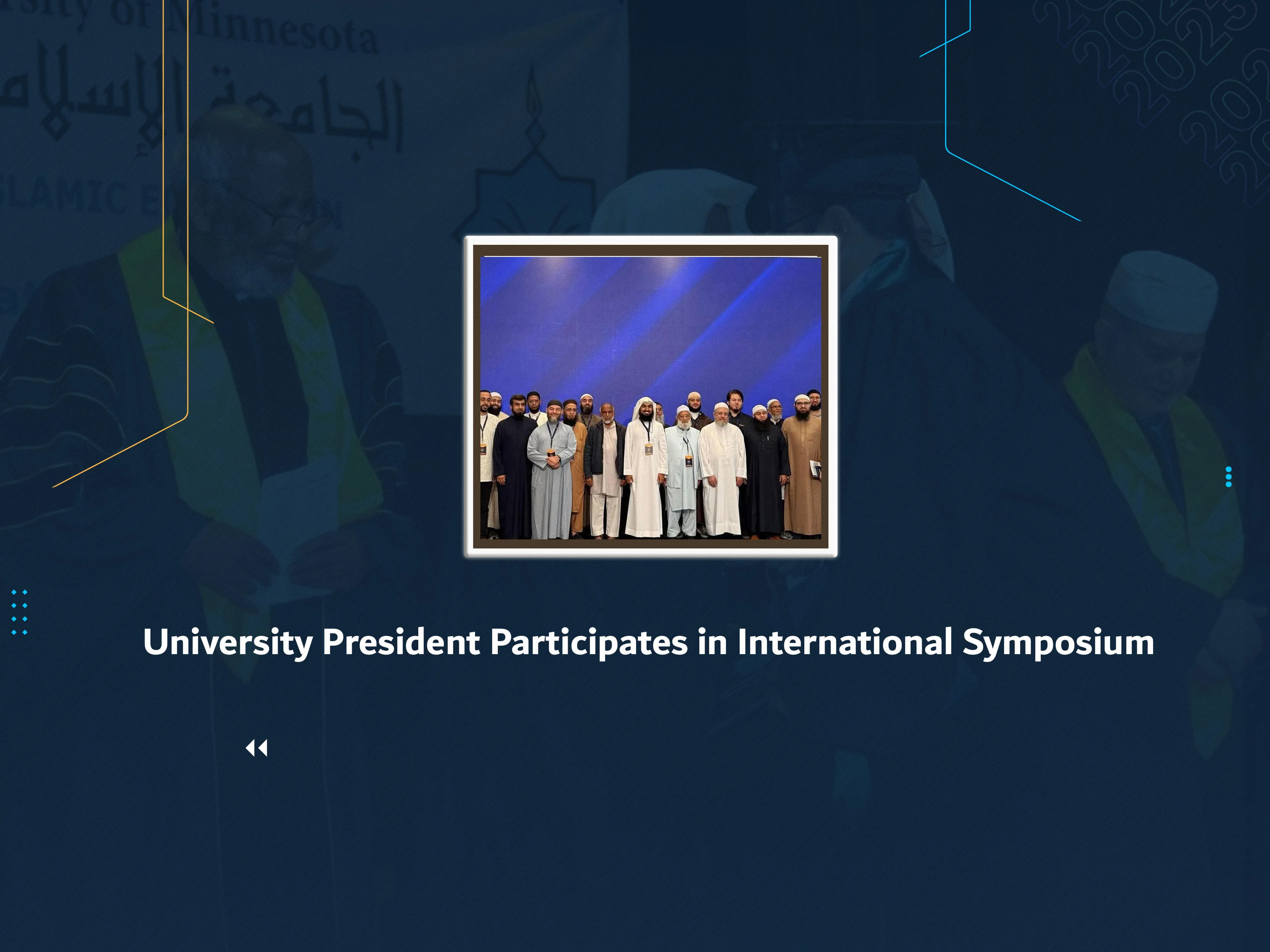
Professor Waleed bin Idrees Al-Meneesi, President of the Islamic University of Minnesota, participated in the Contemporary Issues in Zakat Jurisprudence Symposium, held in Blackburn, United Kingdom, from June 19 to 22, 2026. His participation came at the invitation of Foundations of Legacy, alongside a distinguished group of leading scholars, jurists, muftis, researchers, and academics from around the world.
The symposium featured in-depth scholarly discussions on contemporary jurisprudential issues related to the disbursement of zakat funds, combining classical Islamic legal foundations with the realities of modern contexts. The event emphasized the importance of collective scholarly reasoning (ijtihad) in addressing emerging legal questions and developing well-grounded jurisprudential perspectives that respond to the needs of Muslim communities.
In reflections published on his Facebook page and later shared by the University President, Dr. Mohammed Al-Saeedi described the symposium as a distinguished model of constructive scholarly dialogue, noting that its sessions were characterized by fairness, sincerity in the pursuit of truth, and a firm commitment to rigorous academic research and institutional ijtihad.
Dr. Al-Saeedi explained that the symposium's sessions evolved into vibrant scholarly workshops, where participants exchanged ideas and expertise through respectful and intellectually enriching discussions. The gathering brought together scholars, researchers, imams, muftis, and academics representing diverse schools of Islamic jurisprudence from numerous countries, creating a rich environment for thoughtful and balanced legal deliberation.
He highlighted as one of the symposium's most remarkable features the coming together of representatives of the four Sunni schools of jurisprudence alongside scholars of the Hadith tradition under one scholarly platform. This, he noted, reflected the breadth and inclusiveness of Islamic jurisprudence and demonstrated its capacity to embrace diversity of opinion through disciplined scholarly reasoning, free from sectarian bias or rigidity.
Dr. Al-Saeedi further praised the symposium for fostering open and meaningful academic dialogue. Beyond the presentation of research papers, participants engaged in thorough discussions in which legal evidences and scholarly opinions were carefully examined according to established principles of Islamic jurisprudence, reinforcing the symposium's role as an exemplary model of institutional collective ijtihad.
He also commended the symposium's exceptional organization, noting the high standard of planning, warm hospitality, and smooth management of the scientific sessions. He emphasized that the participation of prominent scholars, members of leading fiqh academies, and representatives of respected academic institutions significantly enriched the discussions and contributed to more comprehensive and mature perspectives on the issues under consideration.
Concluding his reflections, Dr. Al-Saeedi stated that the symposium embodied the true spirit of collective scholarly reasoning, where knowledge and expertise were brought together in service of the Muslim Ummah. While zakat served as the central theme of the gathering, he remarked that Islamic jurisprudence itself—and the culture of responsible scholarly dialogue-was its greatest beneficiary. He also expressed his appreciation to Foundations of Legacy, particularly Dr. Sajid Umar, for organizing the symposium and promoting high-quality scholarly initiatives that serve Islamic jurisprudence and address contemporary challenges.
Fiqh Symposium 2026 marks the inaugural specialized research symposium organized by Foundations of Legacy as part of its scholarly platform. This year's symposium focused on "Zakat, Public Interest, and Advocacy in the Context of Muslim Minorities," bringing together leading scholars representing the four Sunni schools of jurisprudence to examine peer-reviewed research and engage in scholarly deliberations. The symposium aims to establish a sound academic reference and institutional standards for the governance of zakat funds in addressing contemporary jurisprudential challenges. The event was held by invitation only under the academic supervision of Islamic Finance Advisory, while Foundations of Legacy, under the leadership of Dr. Sajid Umar, continues to organize scholarly initiatives that strengthen academic collaboration among scholars and contribute to research and juristic guidance benefiting Muslim communities worldwide.