

Department of Fiqh and Its Principles Holds Preparatory Meeting
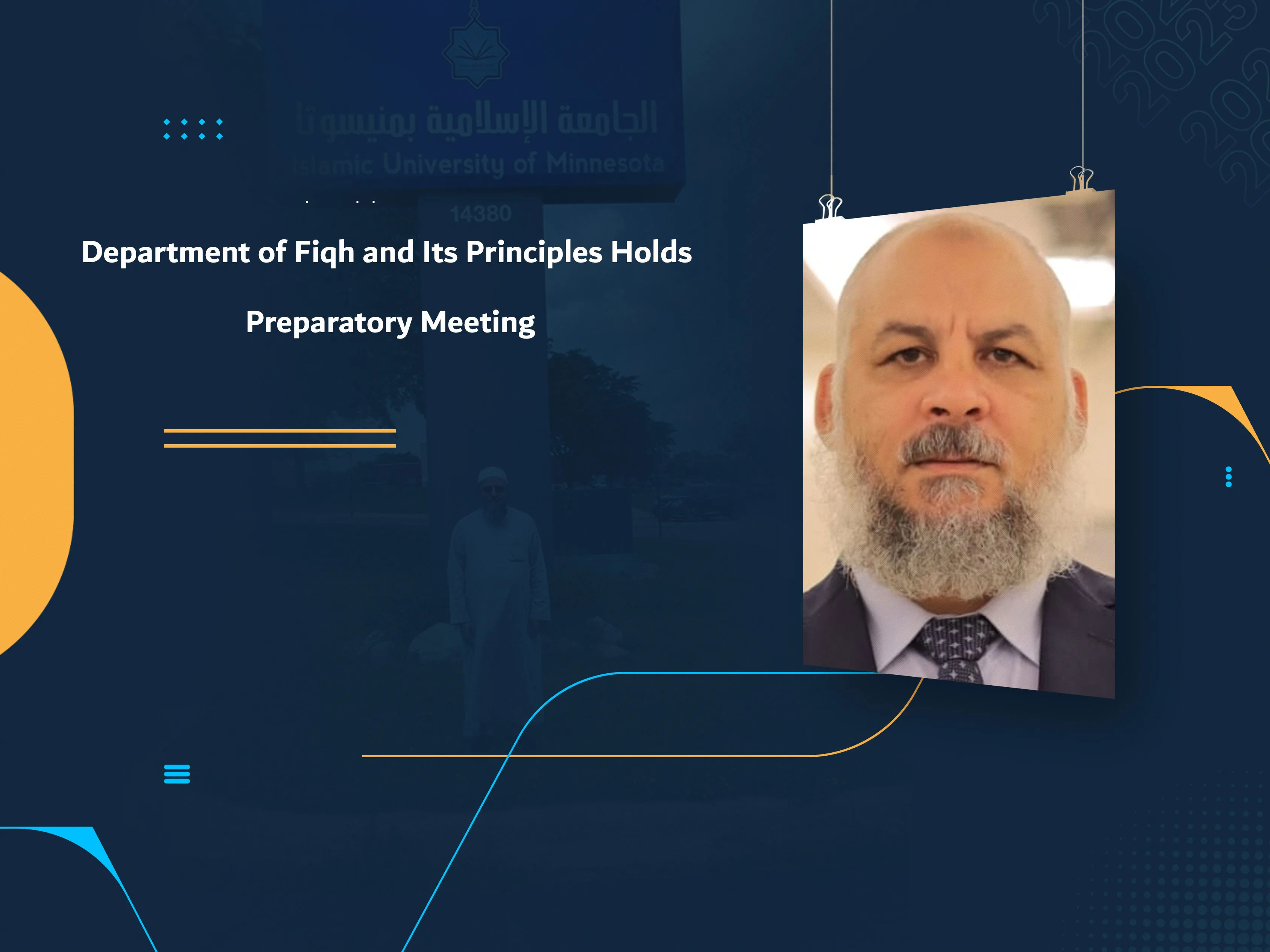
As part of its preparations for the First Semester of the 2026-2027 Academic Year, the Department of Fiqh and Its Principles at the College of Sharia and Law, Islamic University of Minnesota - Main Center, held an academic and preparatory meeting on Friday, June 19, 2026, chaired by Dr. Salah Faraj, Head of the Department, with the participation of several faculty members. The meeting focused on reviewing academic and organizational preparations and finalizing the necessary arrangements to ensure a successful and well-organized start to the new academic year.
Opening the meeting, Dr. Salah Faraj welcomed the faculty members and emphasized that early preparation and systematic planning are fundamental to the success of the educational process. He noted that these efforts reflect the department's commitment to providing an outstanding academic environment that meets the highest quality standards and contributes to enhancing the quality of its academic programs and learning outcomes.
The meeting included a comprehensive review of the academic plan for the upcoming semester. Participants confirmed that the semester will extend over twelve weeks, with the midterm examination scheduled for the seventh week, while the final examination will be held at the end of the semester in accordance with the University's approved academic calendar, ensuring the smooth implementation of the educational process and adherence to the planned schedule.
Faculty members stressed the importance of regular attendance and academic discipline, emphasizing that consistent participation in lectures is essential for achieving the intended learning outcomes. They noted that repeated absenteeism negatively affects students' academic performance and may result in the application of administrative measures stipulated in the University's regulations, thereby reinforcing a culture of responsibility and academic commitment.
The meeting also discussed the importance of thorough preparation for lectures and the adoption of modern, interactive teaching methods that encourage student participation and develop their academic and research skills. Participants further emphasized the need to take into account the cultural and linguistic diversity of students and to use clear and standard Arabic in delivering course content to ensure effective communication and understanding.
As part of efforts to enhance the learning environment, faculty members highlighted the importance of utilizing modern instructional technologies by preparing presentation slides, academic materials, and lecture summaries and making them available to students before examinations. Such measures were recognized as effective tools for helping students prepare for assessments and improving their academic achievement.
With regard to the assessment system, the meeting reaffirmed the implementation of the University's approved grading policy, allocating 20 marks for attendance and participation, 20 marks for the midterm examination, 20 marks for assignments and coursework, and 40 marks for the final examination. Participants agreed that this balanced assessment framework supports both continuous evaluation and final assessment while providing a fair and objective measure of student performance.
The meeting also endorsed granting faculty members an appropriate degree of academic flexibility in selecting and emphasizing priority topics within course syllabi, enabling them to achieve course learning outcomes, enrich academic content, and maximize students' educational benefit.
Participants further reviewed the status of the department's courses, noting that the publication of some course materials on the University's learning platform was still in progress. They emphasized the importance of continuing coordination with the Curriculum Unit to complete the process as soon as possible and ensure that all courses are fully available before the beginning of the semester.
The meeting concluded with several executive recommendations aimed at strengthening academic readiness. These included completing the registration procedures for newly appointed faculty members on the University's electronic portal, preparing lecture files and academic materials and uploading them for students before the examination period, limiting coursework to one academic assignment per course during the semester, and maintaining close coordination between the Department, the Curriculum Unit, and the Department Secretariat to ensure the availability of all course materials and the efficient implementation of the educational process.
In closing, participants reaffirmed the importance of maintaining a spirit of teamwork, strengthening collaboration among faculty members, and integrating their efforts to enhance academic quality and fulfill the department's mission of preparing highly qualified graduates equipped with sound Islamic legal knowledge, strong research skills, and the ability to contribute effectively to society and the wider Muslim community.
This meeting forms part of a series of preparatory meetings organized by the College of Sharia and Law at the Islamic University of Minnesota - Main Center in preparation for the 2026–2027 Academic Year. These initiatives reflect the College's continued commitment to enhancing academic performance, improving the quality of education and scientific research, and promoting a culture of institutional excellence and sustainable development.