

Department of Creed Holds Academic Meeting
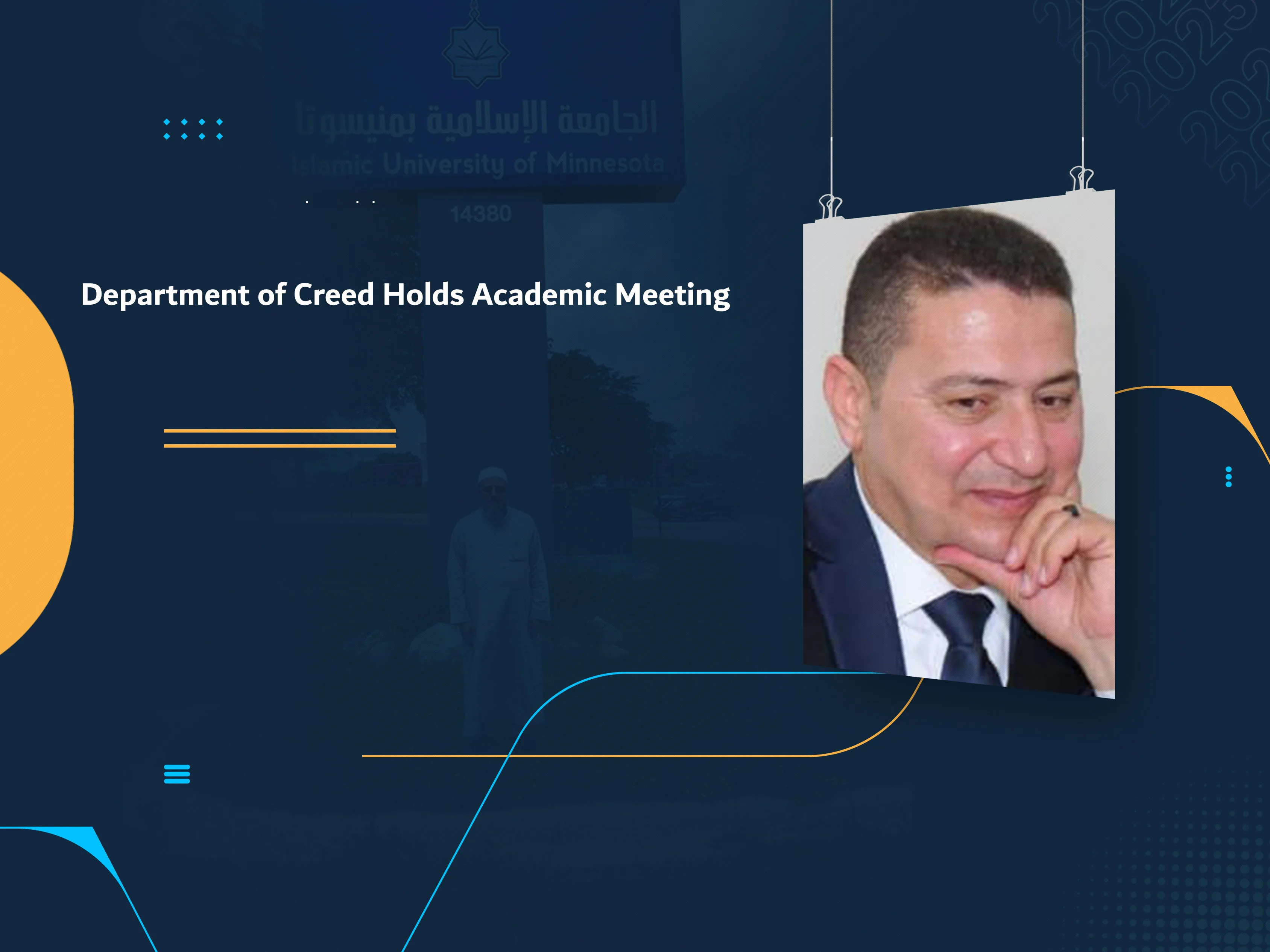
As part of its ongoing commitment to advancing its academic programs and enhancing the quality of educational outcomes, the Department of Creed and Contemporary Schools of Thought at the College of Islamic Studies, Islamic University of Minnesota - Main Center, held an academic meeting chaired by Prof. Emad Al-Din Abdo Al-Ajili, with the participation of faculty members. The meeting focused on reviewing the Bachelor's degree study plan, evaluating academic courses, and discussing mechanisms for their development in line with the University's academic standards and contemporary educational requirements.
At the outset of the meeting, Prof. Al-Ajili welcomed the newly appointed faculty members: Dr. Abdulghani, Dr. Abdullah Hemmat, Dr. Sherif, Dr. Abdulrahman, and Dr. Aziza, wishing them every success in their academic careers. He also congratulated Dr. Majed Al-Harbi on his appointment as Chair of the Department of the Qur'an and Its Sciences, expressing his best wishes for success in his new leadership role.
The meeting featured a comprehensive review of the Bachelor's study plan, during which participants discussed the University, College, and major requirements, as well as the distribution of courses across the different academic levels. Emphasis was placed on developing a balanced curriculum that combines authentic Islamic scholarship with contemporary intellectual and academic developments, thereby ensuring the comprehensive academic and methodological preparation of students.
Faculty members also presented several proposals for curriculum enhancement, including revising the titles of certain courses, introducing a standalone course on Intellectual Security, and updating courses in Islamic Creed, Comparative Religions, and Contemporary Intellectual Trends. These proposals aim to strengthen students' intellectual and doctrinal foundations while enriching the academic content of the program.
In line with ongoing technological advancements, participants discussed the effective use of Artificial Intelligence applications in supporting scientific research and Islamic studies. They emphasized that AI should serve as a supportive research tool while not being relied upon for deriving Islamic rulings or issuing religious verdicts (fatwas). The meeting also considered renaming one of the courses to "Artificial Intelligence and Its Role in Scientific Research" to better reflect its objectives and academic content.
The meeting further addressed the allocation of several courses among faculty members according to their academic specializations. A proposal was discussed to assign the course "Objectives of Islamic Law (Maqasid al-Sharia)" to Dr. Omar Jabr. In addition, several faculty members were assigned to prepare academic materials and development proposals for submission to the Curriculum Committee as part of the ongoing curriculum enhancement process.
The meeting concluded with an emphasis on completing the review of the study plan and submitting all academic proposals within the specified timeframe before forwarding them to the relevant authorities for final approval. These efforts are expected to contribute to the continuous development of the University's academic programs, strengthen the Department's academic standing, and further enhance the quality of its educational outcomes.