

Department of English Continues Preparations for 2026-2027 Academic Year
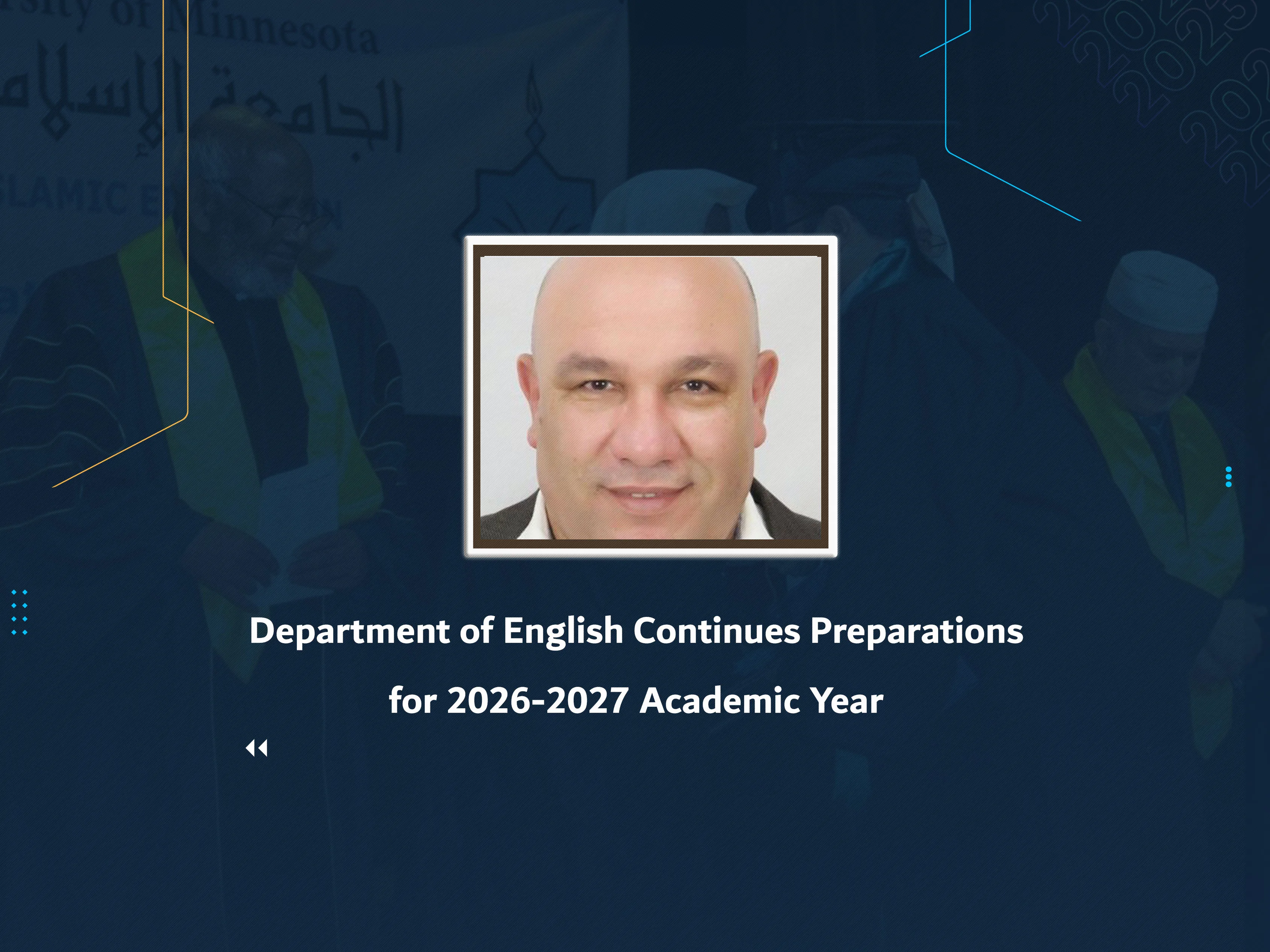
As part of its ongoing commitment to enhancing the quality of education and scientific research, the Department of English at the College of Arts and Humanities, Islamic University of Minnesota - Main Center, continued its preparations for the First Semester of the 2026-2027 Academic Year by holding two consecutive academic meetings chaired by Associate Professor Dr. Khaled Al-Shahawi, Head of the Department, with the participation of faculty members. The meetings focused on a range of academic and organizational issues and reviewed several development initiatives aimed at strengthening the department's academic programs and institutional performance.
Opening the meetings, Dr. Khaled Al-Shahawi welcomed the faculty members and expressed his appreciation for their dedication and scholarly contributions to the department. He emphasized that teamwork and a culture of continuous improvement are fundamental to achieving the University's academic mission and strategic objectives. He also stressed the importance of building upon the accomplishments of previous academic years while continuing to pursue excellence in teaching, research, and academic development.
The meetings included a comprehensive review of course specifications and instructional plans. Participants discussed mechanisms for updating existing course specifications to align with academic standards and intended learning outcomes, as well as preparing new specifications for courses that have not yet been formally documented. These efforts will be based on current scholarly references and aligned with the approved curriculum, credit-hour requirements, and the academic needs of both the English Language and Literature and Translation programs.
The meetings also devoted considerable attention to the development of the University's textbook initiative and the promotion of scholarly publishing. Faculty members discussed ways to encourage the production of original university textbooks and proposed submitting a recommendation to the appropriate University authorities to establish incentive programs for faculty members who author original academic textbooks in their respective fields of specialization. These publications would be issued under the name of the Islamic University of Minnesota and the Department of English, thereby enriching academic resources, supporting scholarly research, and strengthening the University's academic reputation at both the national and international levels.
Participants further discussed the principal challenges encountered during the implementation of the educational process, exchanging practical ideas and recommendations for improving the academic work environment, simplifying teaching procedures, and enhancing communication with students. These initiatives are expected to improve instructional effectiveness and contribute to achieving higher-quality learning outcomes.
A significant portion of the meetings was devoted to graduate studies, where faculty members explored several proposals for the further development of the department's graduate programs. Among the most notable proposals was the introduction of a Research Master's Program, designed as an advanced academic pathway to prepare students more effectively for doctoral studies. Under the proposal, students would complete an additional research-focused year following the traditional master's degree, during which they would study advanced specialized courses and research methodology, thereby strengthening their research competencies and academic preparedness for Ph.D. programs.
Faculty members noted that similar models have been successfully implemented at a number of leading universities in Malaysia, India, England, and the United States, demonstrating their effectiveness in preparing highly qualified researchers for advanced graduate studies. Participants recommended studying the feasibility of adopting a comparable model within the University's academic framework and strategic vision for graduate education.
The meetings also addressed mechanisms for implementing the agreed recommendations. Dr. Khaled Al-Shahawi emphasized the importance of adhering to the established timeline for reviewing and preparing course specifications and instructed that proposals related to faculty incentives for university textbook authorship and the development of graduate programs be submitted to the relevant academic deanships and University authorities for further consideration and appropriate action. These initiatives are intended to support the University's quality assurance efforts and strengthen its pursuit of academic accreditation.
The meetings concluded with a renewed commitment to strengthening collaboration among faculty members, fostering a culture of continuous improvement, and expanding opportunities for academic and research cooperation. Participants emphasized that these collective efforts will contribute to advancing the Department's academic programs, improving educational and research outcomes, and further enhancing the academic reputation of the Department of English and the College of Arts and Humanities at the Islamic University of Minnesota - Main Center on both the national and international levels.