

PhD Dissertation on Imam Al-Awzai's Views Defended
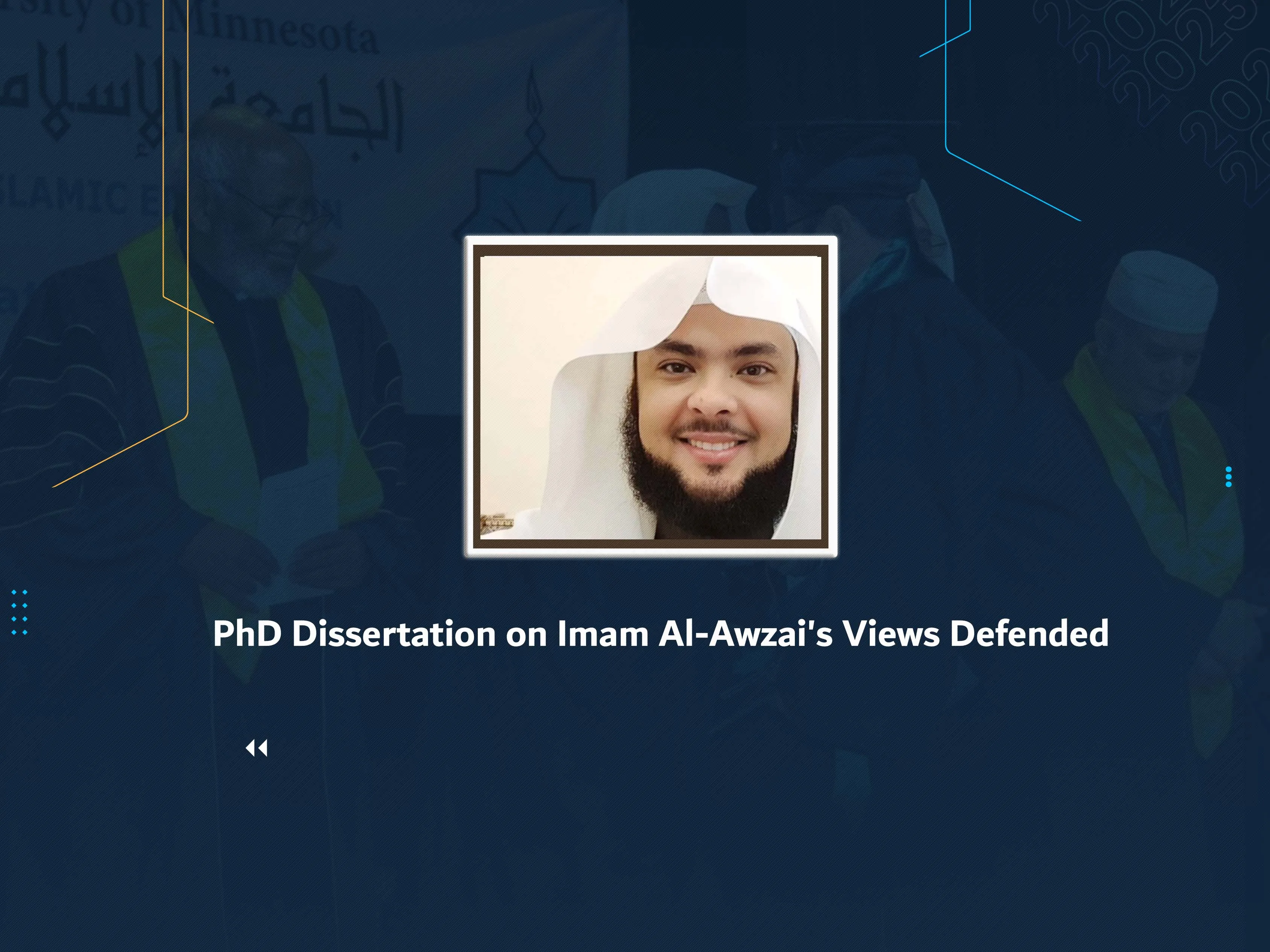
The Deanship of Graduate Studies and Scientific Research at the Main Center of the Islamic University of Minnesota hosted the defense of a doctoral dissertation entitled "Imam Al-Awzai's Views on the Chapters of Purification and Prayer: A Comparative Jurisprudential Study." The dissertation was submitted by Mohammed Hassan Abdu Othman as part of the requirements for the PhD program in the Department of Fiqh and Usul al-Fiqh, College of Sharia and Law. The defense reflects the University’s commitment to advancing specialized academic research and supporting comparative studies in Islamic jurisprudence.
The dissertation examined Imam Al-Awzai's views on a range of issues related to purification and prayer by analyzing his jurisprudential positions and comparing them with the opinions and evidence of other Muslim jurists. The study contributes to highlighting Imam Al-Awzai's scholarly standing and contributions to Islamic legal reasoning, while enriching contemporary jurisprudential studies through engagement with the authentic Islamic scholarly heritage.
The dissertation was defended before an academic committee comprising Professor Dr. Jihan Al-Taher Mohammed, who served as supervisor and rapporteur; Professor Dr. Salah Faraj, Head of the Department of Fiqh and Usul al-Fiqh, as the internal examiner; and Dr. Adel Belkacem as the external examiner.
The committee reviewed the dissertation’s academic and methodological aspects, examining its principal findings and providing a number of scholarly observations and recommendations intended to further develop the study and enhance its academic and methodological value.
The defense forms part of the series of academic dissertation defenses organized by the Deanship of Graduate Studies and Scientific Research, reaffirming the Islamic University of Minnesota’s commitment to supporting rigorous scholarly research and encouraging specialized studies in the Islamic sciences. It also reflects the University’s efforts to advance comparative jurisprudential research, contribute to Islamic scholarship, and highlight the rich heritage of Islamic jurisprudence through academic approaches that combine authenticity with contemporary scholarship.