

PhD Dissertation Defense Examines Legislative Regulation of Alternative Sanctions
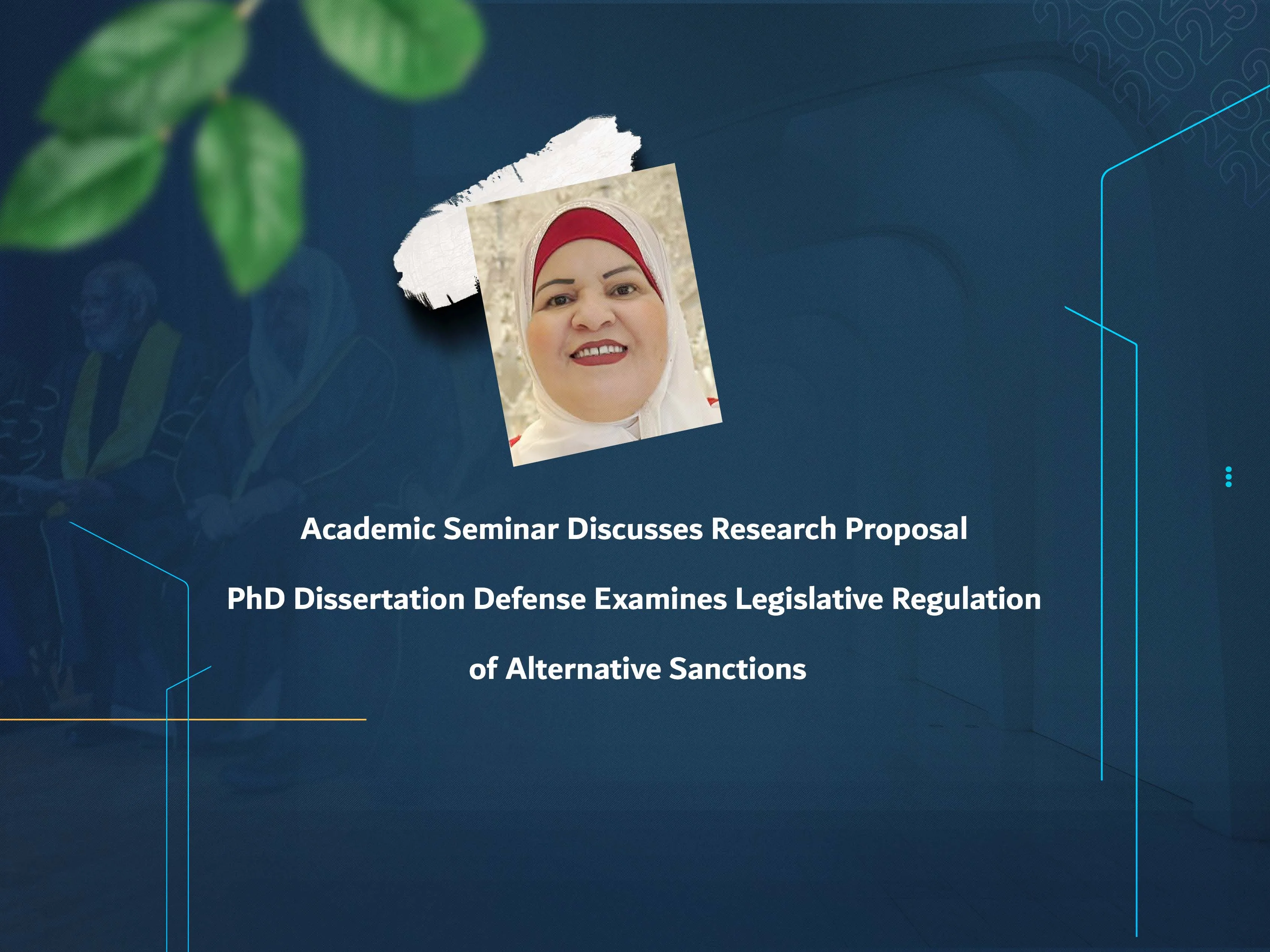
The College of Sharia and Law at the Islamic University of Minnesota - Main Center held an academic defense of the doctoral dissertation submitted by researcher Manal Al-Dhmour from the Hashemite Kingdom of Jordan, entitled “The Legislative Regulation of Alternative Sanctions: An Analytical Study of the Jordanian Penal Code and Islamic Jurisprudence. ”The dissertation was submitted as part of the PhD program in the Department of Law.
The defense was held in person at Safir Hotel in Dokki, with the option to participate and follow the proceedings via Zoom. The session was attended by the dissertation committee, as well as a number of academics, researchers, and professionals interested in legal affairs.
The defense committee was chaired by Professor Dr. Mohammed Shuaib Abdulmaqsoud, Head of the Department of Law, who also served as the dissertation supervisor. Associate Professor Dr. Nancy El-Fiqi and Dr. Ehab Talaat participated as internal examiners, while Dr. Hisham Al-Zoghbi, former Assistant Minister of Interior of Jordan, served as the external examiner.
The dissertation examined the legislative framework governing alternative sanctions through a comparative analysis of the provisions of the Jordanian Penal Code and the principles of Islamic jurisprudence. It sought to identify the legal and Sharia foundations underlying such sanctions and examine their role in developing contemporary criminal policy and achieving a balance between deterrence and rehabilitation.
The study also explored the potential contribution of alternative sanctions to reducing the negative consequences associated with custodial sentences, enhancing opportunities for rehabilitation, and supporting the reintegration of convicted individuals into society, in line with contemporary approaches to criminal justice policy.
The defense featured an in-depth academic discussion of the study’s methodology, research issues, and key findings. The committee members provided a number of scholarly observations and recommendations aimed at enriching the dissertation and strengthening its research dimensions. They also highlighted the significance of the topic and its relevance to contemporary legislative developments, as well as its potential contribution to developing a legal perspective that combines the principles of Islamic Sharia with the requirements of modern criminal justice.
The dissertation defense forms part of the efforts of the Deanship of Graduate Studies and Scientific Research at the Islamic University of Minnesota to support specialized legal studies and encourage research addressing contemporary legislative issues through rigorous academic approaches. These efforts contribute to enhancing the quality of scientific research and enriching academic scholarship with studies that advance legal and jurisprudential thought and respond to the needs of contemporary societies.